Monday, September 26, 2016

Metacognition, or thinking about thinking, is something we learn at an early age but we don't really think about it as being a huge important thing. We learn this as early as 8year olds, or so I assume based on the second grade classroom I  am in. My MT always reads books to the kids. She teaches them new tricks such as summarizing and pausing at periods but this past week she was practicing metacognition.The kids got ready to hear the story and the teacher said she was going to be thinking aloud and that the students should listen, and they did. The teacher made little comments like asking questions about the book, making predictions on the big scenes of the book , and  making infrences on why things were happening in the book or why characters were acting the way they were. At first the kids were having a hard time because they had to pay attention to not only the book and the pictures in the book but also to see what the teacher was asking or saying. Most of them found the activity hard and the teacher assured them it was fine. Lastly, the kids were asked to reflect upon the book. They had to write about what the book taught them. They also never had done that either. Usually, they just write about their favorite part and why but never to reflect on what the story was teaching them.


This video is for my visual learners, it explains what metacognition is and the strategies used for metacognition ie ( questioning, visualizing, predicting and connecting). It explains how it is beneficial for you in the long run the sooner you start practicing it. So my 2nd graders are well on their way, are the kids in your school  practicing metacognition skills?if not why do you think they’re not? And if they are how can you help them get better at it? What age should kids start thinking about thinking?"

Sunday, September 25, 2016

WOW~ It is the first time for me to read this word so I looked up in the dictionary. It says "metacognition" is a psychology term which means awareness and understanding of one's own thought processes. When I go back to the article, I found out an explanation that is more friendly for us to understand the term.  We can regard "metacognition" as a self-checking procedure while one's learning. It is a mental activity that we realize whether or not we understand the texts that we read or a statement that we heard. 

Image result for metacognition


There are three categories under metacognition: 1) Metamenory and metacomprehension (It is amazing to see that all these "meta-" words are underlined when I typed them!): referring to an understanding of one's own knowledge state (What do you know?).  2) Problem solving: persuiting of a goal when the path is not clear (What would you do to reach the destination?). 3) Critical thinking: evaluating and judging if ideas make sense.

My mentor teacher uses reading log a log. I think it is a very good way to use metacognition. Students in my class are required to read for 30 minutes for any books they want every night. And they have different reading logs to fill out after they finish reading. There are questions like: who are the main characters in the story? what is their relationship? what is the setting of the story? ,etc. I think it is an effective way to make students think about their own thinking. They will be aware of whether or not they understand the texts after reading. 
Image result for metacognition
I think the picture above is a good example of using metacognition. All these questions can be used as self-check questions for students to think back whether or not they understand what they have learned. We can use it in any grade levels and any subjects.

My question for you guys is :
Have you ever seen any examples about this topic in your field work?
Under what situations did your mentors apply it to their teaching?

Thank you for reading! Have a good night! :)

From Bing :)

Metacognition, Thinking about Thinking


  Hey! So this week we will be talking about metacognition and how it helps students read across disciplines.  I really liked the articles this week because not only did it give me a better understanding of how I could actually practice disciplinary literacy but it made me realized it is actually something that I see being applied in my own classroom. Lets start of with metacognition, what does it mean? It simply means to think about your thinking. I know it sounds simple, or vague but I think it can be better explained by giving you the examples of how I see this practiced in my class. but first let me give you the inside scoop about my class.

 I am in a departmentalized fourth grade transitional bilingual classroom, my students are having a bit of a hard time with this transition for they are no longer able to speak in Spanish nor are we allowed to support them through the language but instead have to try to help them articulate the words in English. We teach Reading and Social Studies and are trying to figure out what is the best way for them to get the most of their reading experience for all of our students are below their reading level.

 My mentor teacher and I have been working on their stamina and are currently working on metacognition. We began by modeling how you can go writing down questions or thoughts that you have on sticky notes, as you are reading. The students were able to practice this for about a week and then we introduced buzzing. This was also modeled for our students by my mentor teacher and I. The point of buzzing is two people share and discuss what they wrote about when they were reading their just right book. (their independent reading level book) The students were suppose to comment on what the other wrote and ask questions. We just started doing this but I can already see this helping them, they were asked to share after their first buzzing session and it seemed as if they were getting a deeper understanding of what they were reading. I also liked how one of the articles talked about this helping students who are not at their reading level, and it helped teachers not see their students as "hopeless". I've personally seen this happen, teachers feel the extra pressure when their students are two years "behind" when it comes to reading level. I think these kids just need the right tool box that works for them.


So I guess my question would be have you seen metacognition being applied in you classrooms? Do you think it will be beneficial? I would love to hear specific examples of this in our disciplines!

Thanks for reading gals and guy! lol (:

I know what metacognition is, but I can't find it!


Metacognition is one of those words that your eye tries to avoid when reading. We all recognize the word cognition in there, but the four extra letters 'meta' add a lot to the meaning.
When I was first introduced to the word, I was very confused about it. My teacher spent two weeks explaining what it is and giving examples. But when I took the test at the end of the two weeks, I was stuck on the first question. She asked us to give the definition of metacognition. I knew what it meant, I was able to give her examples, but I could not put a sentence or two together to define it. It was such a big idea that I couldn't put it into words unless I wrote a whole essay! Most of the class missed that question. When the teacher passed them back, she told us "well I really did not want to tell you guys the basic definition of metacognition because I wanted you to come up with a better one. But since lots of you could not, the best way to think about metacognition is: the process of thinking about thinking". This was the sentence that popped up in my mind when I read the Martinez article because the same exact words were used. Martinez even mentioned that this definition needs a lot more explaining. But what helped me understand it better is the way Martinez broke it down and put it in words young students can understand.

Three Categories:
1) Metamemory and Metacognition: "One's own knowledge state".
2) Problem solving: "What you do when you don't know what you're doing".
3) Critical thinking: "Evaluating ideas for their qualities".

When I was reading I kept getting lost with all the different ideas and dimensions thrown at me. That point is when I realized how big the idea of metacognition is.
One thing kept going through my mind when I was reading all the articles. I was so sad to realize that even though teachers know about this, no one uses it. Every class that I have been in had a focus of students improving test scores. Students are trained through every single activity to become a better test taker. They are taught to work hard and study for a test coming up every day of the week (whatever test that may be).
I know that testing is a good/effective way to assess student work. But it shouldn't be the only way!
The stress that teachers are under to do their best so that their students can pass state tests is the reason teachers cannot teach the way they want. I am sure many teachers are against the curriculum or testing strategies, but what can they do about it? This question or issue has been on my mind since I started my field work and saw how classrooms operate.


I would like to know if any of you have a different view or may have a potential solution.
Here are some questions I would love to hear back from you guys about.

-what were your experiences like with this issue in your placements?
-do you guys think that when we become teachers we will be pressured into the same cycle?
-what can teachers do to integrate metacognitive activities/assessments into their classroom?

Making Students Apprentices

I cannot remember which of my teachers first introduced the word metacognition to me and the rest of my classmates. However I do remember she was blonde, so it was either my seventh grade teacher ELA teacher or my third grade teacher. In "What is Metacognition?" Martinez said that many teachers define metacognition as "thinking about your thinking." Although I cannot remember which teacher introduced me to the term, I do remember she defined it just so.
I wanted to open with this anecdote because it was the first thing that popped in my head when I saw these readings were on metacognitive processes. Now, before we dive in, here's a picture of someone thinking about thinking.
"Ah basta de pensar" = that's enough of thinking
However metacognition is more than just thinking about the way you think.
Apprenticing Adolescents to Reading in Subject Area Classrooms
There was a lot about this reading that I liked, since it broke things down and gave some great examples of real-life teachers building up students literacy skills in different domains or disciplines. A lot of what we as a cohort have already learned about good teaching and perhaps witnessed in the classroom is very similar to this idea of apprenticeship.Before this we have talked a lot about Vygotsky's zone of proximal development and on how to scaffold students. These definitely connect to metacognition and the idea of apprenticing students, although these ideas seem more expansive. I like how the was broken up into four dimensions, so I am going to highlight those in my own response.

Four dimensions 
1) Social Dimension: building a community of readers
     This dimension is about establishing a sense of community and safety among the students when it comes to reading. I feel like this one is super important, because without it students will not want to move forward. For this dimension the reading talked about students feeling safe enough to share what they did not understand. I believe this needs to encompass students reading and speaking as well. Students must respect one another's thought processes, as well as each other's reading abilities and literal voices.
In my own classroom this past week, we were doing a worksheet as a class that involved some science and math. It was about bugs and their masses. There were two short paragraphs on the page, and one of the students who volunteered to read was laughed at by several students for how he pronounced something. I interjected to let the students know that it was not okay to make fun of someone else for how they were reading or speaking. This is something that my classroom will definitely have to work on so that we can tackle more challenging disciplinary material together.
2) Personal Dimension: giving apprentice readers a feeling of capability or agency
     This personal dimension builds nicely on the first dimension. For students to feel capable they must first feel safe and supported.
3) Cognitive Dimension: acquiring tools to comprehend texts
     It is vital for students to have reading strategies. It is also vital for students to see other people, especially their teachers, using reading strategies. We have to model what we do to make meaning out of texts, and we have to do it often so that students can see that even the experts use strategies. Some of this is specific and graphic strategies like those we present for each other every week in class. Some of it is also little things like doodles and comments in the margins of a book or other type of text. 
     I particularly like how the readings talked about making your "invisible" strategies "visible" and allowing students to see how you, a grown person, struggle sometimes and how you overcome it. This is something that is simple but can go a long way with your students, especially since many of them do admire you.
     When my class was working on the worksheet about bugs I mentioned earlier in this post I walked them through how I visualized one of the facts on the sheet in order to understand it. It was something about a certain insect having 3-30 times the biomass of humans, depending on the area. So I invited the class to close their eyes and visualize it with me in order to understand what the text was saying. They loved it, and I could see on some of their faces the meaning of this fact clicking. 
4) Knowledge-Building Dimension: connecting to prior knowledge and building on it
     This is something that is essential for us to remember to do with our students. There is even a section in our edTPA lesson plan template that asks us to examine our students' prior knowledge that may relate to the lesson. It is something that can make scary new concepts familiar and accessible to students.

My questions for you (answer as few or as many as you would like)
- Do you see your mentor teachers doing any sort of literacy apprenticeship in the classroom?
- Are there any ways you are thinking of implementing this apprenticeship framework during your student teaching or later in your own classroom?
- What are some of the strategies you like to use when making meaning?
- What was confusing to you about this week's readings?
- Any questions about what I wrote here?

Thank you for reading :) 
Metacognition
                According to the reading, metacognition is the act of monitoring and control of thought. While I was reading the article, I kept on thinking how I can implement this into my teaching. I can't help, but tying this to teaching for  social justice and how we should give the students the opportunity to be aware of what is really happening in their community. I feel that teaching for social justice and implementing metacognition  in the classroom can go hand in hand, because in metacognition, students are checking whether they comprehend what they are readin, and whether what they are doing make any sense. Therefore, there are so many strategies they can use to help them make sure they are really comprehending the text. The way we might be able to combine social justice and metacognition might be giving the students the opportunity to read articles regarding their community and see  if they can come up with a strategy to make sense of the text.


So looking at the illustrations, how would you use metacognition and tying it together with teaching for social justice? Do you think teachers can incorporate metacognition  with teaching for social justice? Please explain.   Have you seen teachers using metacognition in your field work and how do they use it?

Sunday, September 18, 2016

Digital Literacy

Over the years, I think we have all noticed the major increase in electronic texts.  Online texts and print forms are everywhere.  As someone who has always been about using technology, I have found myself changing over to the digital print.  Most of my news comes from reading articles online.  Over time I have become more used to reading novels and text books on a screen as well.  With the sometimes drastic lower price, digital text books have become more prominent lately for our college classes.  I have never had a problem with any of this and it's even environmentally friendly by not having to use paper.  But in the reading by Pandya, it is talked about how the electronic forms "open up space for expanded and enhanced practices of critical literacy".  While this could be a good thing, the article also points out the other side saying "that educators would have trouble learning about and subsequently integrating these fast-developing digital literacies into curricula in a timely way".  In a lot of ways I agree with this.  As much as I am capable of being able to read and get books digitally, how can I know how to best use the digital forms in my class? Do you guys think that there will eventually be a time where everything is digital? I think that there is going to have to be something out there eventually that helps teachers with this, whether it be in actual teacher prep courses or in their schools they work in, because all the young kids are growing up with more and more technology and become better and more familiar with it.  I think that because of that, it might hurt them if they are not able to involve their technology skills in the classroom and in schools.  While I don't think that kids should just sit on electronic devices all day, if it is because they are reading and doing all their school work and helping them grow, then how can I be against it?

Just looking to see what you guys think.  Feel free to challenge or go along with anything I have brought up.

Rhys

Critical Digital Literacy


We've read about the importance of critical literacy in the classroom, but the reading "Traveling, Textual Authority, and Transformation" by Avila and Pandya from this week is one of the few that focus on the digital aspect of critical literacy.

Obviously, technology is a major factor in society today and it's only going to increase in the future. Nowadays, children grow up using technology almost everyday. Because of this, it would make sense to incorporate it into their educational lives.
Image result for technology and children statistics
 Avila and Pandya argue that "critical digital literacies have the potential to reach learners who might be otherwise reluctant to engage in print-based critical literacies work" (3). This reminds me of when we learned about deficit vs resource ideology. We should use the fact that student's are exposed to and familiar with technology as a resource in our classrooms. However, I understand that not all schools will have the funding to supply every student with a Chromebook, iPad, etc. That being said, digital literacy should not be the only form of literacy in the classroom, but should be seriously looked at as an important tool to use if possible.

In the 4th grade classroom I'm currently in, each student has a Chromebook with which they do research, use educational websites, watch educational videos, take quizzes/tests, and write essays among other things. I can see how beneficial it is to have that technology as a resource. The students and teachers are able to get their work done more efficiently, the students have access to more information, and the students are able to learn the content in a way that is most beneficial to their learning style (e.g. visual, auditory, etc.). The students seem to be much more engaged in the content when it is given to them on the Chromebook. The activities they do on it are much more enjoyable and interactive than those done in workbooks/textbooks.

I'm curious as to what your opinions on digital literacy are:

Do you think digital literacy is more/less important than traditional print literacy? Or are they equally important?

When should digital literacy be introduced into a curriculum (elementary school, middle school, high school)?

What experiences have you had (in fieldwork or your own education) with digital literacy?


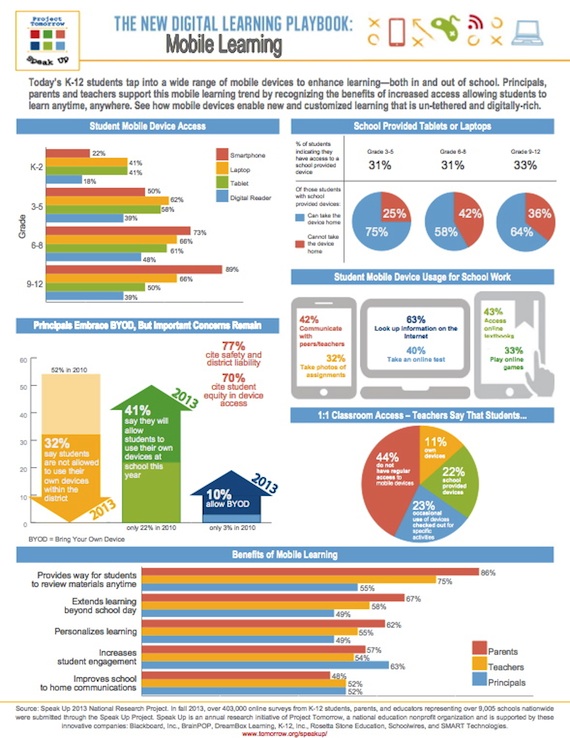
For those visual learners like me, here's a graphic representing the use of technology in schools.
Speak Up Survey Details
link to where this graphic is from: 
https://thejournal.com/articles/2014/04/08/a-third-of-secondary-students-use-school-issued-mobile-devices.aspx


Saturday, September 17, 2016

Literacy Ideology

Literacy Ideology:
Critically Engaging the Language Arts Curriculum
Cadiero-Kaplan


Functional Literacy

Functional Literacy is where skilled deemed necessary to participate in society are the focus of instruction. This includes the ability to read and write, use formal grammar and phonemic awareness. This ideology is the mechanics of being able to read. While these skills may be important it completely ignores any critical thinking beyond the text and lacks connection to students' lives. 

Unfortunately, this is the literacy ideology that many English Language Learners receive in schools or any children labeled "at risk" because it is essentially the bare essentials of getting by in society. This is teaching the basic job related skills.


Cultural Literacy

This is known as the "Core Knowledge" Approach to literacy instruction. The main focus of the ideology are morals and values. It places a priority on the information that readers bring to discussion. Diverse groups of learners are able to be successful in school and access the mainstream culture. 

Cultural literacy is the "avenue of opportunity" that supports the literacy learning of disadvantaged children. The core of literacy is focused on whole group experiences, that a negative side to this ideology is that any individual or community experiences are left out from the learning.


Progressive Literacy

The progressive ideology is based on student interest, needs and inclination. It works with democratic views so that interchange between students and teachers further literacy learning. Unlike Functional Literacy, Progressive revolves around the process of learning. This process is mostly focused on reading and writing based on the leaner's own topic of interest that allows vocabulary that is related to their lives. The students take on their own literacy learning.

This seems like a great literacy curriculum option though it does not question any cultural or political contexts. Which is a definite problem because we literacy is a socially constructed.


Critical Literacy
"The Social Transformation"

The critical form of literacy ideology empowers learners to actively participate in the democracy we live in and moves literacy in schools to a new platform of social action. The students are constantly critiquing literacy, dialoging with peers about their thinking and engaging in self-relfection. Critical Literacy values individual voice, experiences and histories. The teacher's role is to introduce a problem that then children are able to reflect on and are supported to respond to in one's own language. 

There is a need for Functional Literacy in this ideology because of all the mandated and standardized tests that require skills of decoding, fluency and other building block aspects to literacy. 


Do you guys like one ideology more over the others? How would you use it in the classroom?

I feel like there are important aspects in literacy in all of them and that not having a set literacy curriculum would allow for more creative approaches that cover all these ideas.

What are your thoughts on Critical Literacy? I felt that is was looked at as the answer to literacy instruction by Cadiero-Kaplan. 


I found a cool clip of a film that was made based around the issues of critical literacy and reading in schools. I have not watched this full film but it sounds interesting!

(There is some naughty language so please cover your ears! My apologies.)


Thanks Y'all! :D


Disciplinary Literacy for Social Justice


Disciplinary Literacy Pedagogy as Cognitive Literacy Process

And

Disciplinary Literacy Pedagogy as Navigation Across Cultural Boundaries


In Developing Socially Just Subject-Matter Instruction: A Review of the Literature on Disciplinary Literacy Teaching, Moje dissects different approaches and perspectives of Disciplinary Literacy towards social justice. The two teaching practices of disciplinary literacy that stood out to me were “Cognitive Literacy Process” and “Navigation Across Cultural Boundaries” because in class we’ve discussed about teaching students to be mini experts (authors, researchers, scientists, mathematicians, historians, etc.)  in all subject areas as a means of providing equal opportunities, access, and making connections to the real world.


Cognitive Literacy Process


 This pedagogy focuses on teaching cognitive strategies that supports comprehension of texts while also drawing from what students might be interested in as they read.  The aim for this model is to provide opportunities for youth to learn to independently access and evaluate different types of text that they need in order to be socially involved in society. Mainstream schooling has always revolved around Euro-centric perspectives and culture which are not relatable to our diverse group of youth.

Ø  How can we use this type of pedagogy to support students in being actively involved in social justice?
Ø  What kinds of texts or resources do we need in order to do so?

Navigation Across Cultural Boundaries Image result for cultural education cartoons


This pedagogy focuses on teaching subject-matter beginning with students’ interests, knowledge and practice as a way for them to learn content knowledge. This advocates “teach the student not the subject” through practice of navigating across the different cultural, discursive, or linguistic communities. In other words, students learn interactively through critical action projects, community projects, and human interaction. Even though this pedagogy focuses on documenting and analyzing youth text and cultural practices, it leaves text practices of the disciplines more vague.


Ø  How does navigation across cultural boundaries support social justice?

Ø  How can we incorporate more subject/content based practices into this pedagogy?


For me, combinations of both pedagogies are important because in order for our youth to be active participants for social justice they need to have the content knowledge, evidence, socially interactive skills, and community awareness.


Ø  What do you guys think? Agree or disagree?

Ø  Or what were your favorite pedagogies for social justice?


Thanks for reading J

Thursday, September 15, 2016

Technology in Schools


The reading that stood out to me the most was "Traveling, Textual Authority, and Transformation: An Introduction to Critical Digital Literacies" by Avila and Pandya. I do not like the fact that technology and textbooks online are becoming a big part of the classroom. There are positives and negatives of it but I think paper texts should be included. I am big on the issue of technology at it taking over a person's life. I think keeping old school texts and methods in the classroom keeps the classroom alive and kids focused. 

For example: when a teacher uses chrome books, the kids get distracted and go on different websites with hacks they figured out. 


Literacy Ideologies

The article by Karen Cadiero-Kaplan discusses literacy ideologies. Before I read this article, I kind of just assumed that having a literacy ideology meant thinking that all students needed to learn how to read. Clearly I was wrong. So I then was thrown at the idea of it being more complicated than that and then completely was driving the struggle bus as I tried to navigate between the three types of literacy ideologies presented: functional literacy ideology, cultural literacy ideology, an progressive literacy ideology.

Functional literacy ideology is that students need to be taught skills thats will teach them to be successful in school and society. Basically, to be considered to be functionally literate means that a person can read enough to participate in day-to-day activities and to survive. Cultural literacy ideology is that students need to be taught about the culture, values, and morals of society. The under the radar part of that is that it is the dominant culture's culture, values, and morals and doesn't represent any other groups. Progressive literacy ideology is that students need to curriculum that involves the interests of the students. It is about taking advantage of what the student's bring to the table.

Now, I am not one of those people who fits very nicely into one box. So for me, the challenging part is figuring out what I like about each ideology and what I don't like (cough obviously the part about only teaching the dominate culture's culture cough). I want to know how to fit all of these different forms of content into a literacy block without leaving the students unprepared in some areas that do not get touched on as often. I think it is difficult to navigate what parts of each ideology work best with my teaching style and philosophy but also difficult to navigate what parts will help each student succeed to their fullest potential.

What are do you all think? Is there to way to get the best of both worlds and teach it all?


Sunday, September 11, 2016

Disciplinary Literacy

Before this class, I didn't really understand what disciplinary literacy meant. I am finally starting to understand it the more we are reading and learning about it. As I was reading chapter one "Mentoring Students in Disciplinary Literacy" in Buehl's "Developing Readers in the Academic Disciplines," I was very interested in the concept of reading being tied to identity. Something that I found very interesting was when Buehl states, "...teachers can directly through their language encourage the creation of new identities. "As a person thinking like a scientist, what might you suggest?" What did you notice as a reader when you read that passage?" (Buehl, 8). This reminded me of CI 402 when we went over how different reading strategies can be more engaging and beneficial for the reader. This also made me realize that it is important to use the appropriate language to promote different reading styles so that the readers get the most out of the assigned reading and know how to interpret it in a way that makes sense depending on how the reading is being analyzed.

As I was reading, "Disciplinary Literacy: What you want to know about it" by Zhihui Fang and Suzanne Coatoam, it gave me some clarification and helped me understand what Discipline Literacy actually means. I don't think that literacy should be taught as it's own discipline because I believe that students will get more out of literacy when it is integrated in different disciplines. Growing up, I remember reading and writing in all different subjects and I enjoyed it because it allowed me to explore reading through different subjects which makes it more interesting. I think this will help enhance the students in their learning because they are able to learn from different areas and gain different perspectives.

Posing questions or using the vocabulary that Buehl was mentioning in his chapter ties really well with this. Asking a student to think like a scientist if they are reading something in regards to science, or asking them to think like a specific character allows students to explore different perspectives and gain more insight on the reading that they are doing. They are not being limited and can get a lot more they are exposed to different disciplines.

At some of the schools that I have observed at reading was integrated in all subjects. One school in particular didn't have science. During their reading block, they read different articles and had really good discussions about the reading. They were very interested and dialogued with each other really gaining insight from each other's thoughts and perspectives. It was great to see.

My questions that I pose to you all are:

1. Do you think that literacy should be integrated throughout different disciplines or do you think that it should be taught as it's own separate discipline?

2. In your field placements, have you seen literacy being integrated in all subject areas or have you seen it taught as it's own discipline?

3. What are some ways that you might implement this in your classroom?

Disciplinary Literacy

Until this class, I had never even heard of disciplinary literacy.  For the most part right now, it is still something I am not totally sure I would be able to explain it to someone who had never heard of it either.  However this article has made it clear that it can be pretty important and can help all of our students.  When they mention that many students are struggling to read in write in subjects that aren't reading and writing, it makes me think of when we are in schools with the children.  A lot of the schools we have been in for primary grades, teachers/students days are generally revolved around math and reading.  For my experiences, when I ask about social studies or science, teachers tend to say that they integrate it into the math or reading sections.  For example the class could be reading about the stars and planets and learning about our universe.  So they are practicing their reading but also learning about science.  I feel like there is this sort of teaching reading and writing across subjects but teachers don't seem to make it known to the students that they don't have to just be studying "one subject" at a time.  But that certain topics or activities can be combined and help you succeed.  What are your thoughts on this? Do you like this type of teaching? Should we not departmentalize subjects until high school? Or you might completely disagree/hate everything I've said or the article has said.  Thanks for reading. Let me know

Rhys

Tuesday, September 6, 2016

Disciplinary Literacy (What You Want to Know About It)

To be honest, ever since the semester began I have been slightly confused on what the term disciplinary literacy even means. The readings kind of confused me even more, but then as I began reading this article, it clicked. I think that it makes a lot of sense to kind of spread the teaching of literacy across all subjects and to focus on the literacy of each subject separately. I think this makes sense because the article states that two-thirds of students struggle reading and writing texts that are in different content areas, so something has to change. Do you guys think that literacy should stay as its own discipline per say, or do you think literacy should be taught across the board? How else could we improve this?